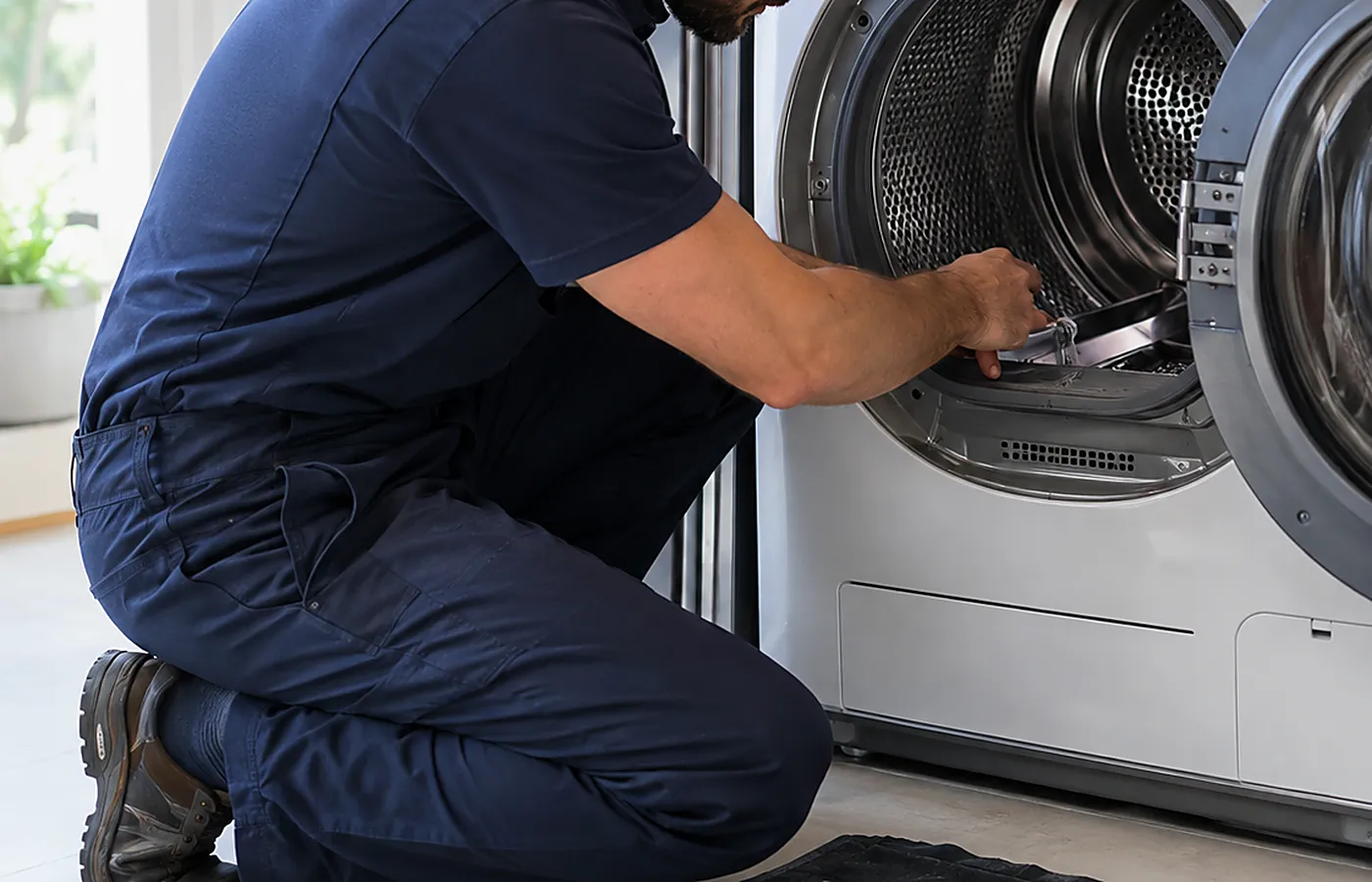
Start with the lint screen and visible airflow path.
Clean the lint screen before every load and inspect the visible transition duct for crushing or severe kinks. A dryer needs moving air, not just heat. If moisture cannot leave the drum, clothes can remain damp even while the cabinet feels hot.
Do not reach into a running dryer or remove panels to inspect the blower unless you are qualified. External airflow observations are safer and often highly informative.
How can a restricted vent increase drying time?
Lint buildup, long duct runs, crushed flexible ducting and blocked exterior hoods can reduce exhaust flow. Restricted airflow may extend cycles and increase operating temperature.
If the dryer is hot but clothes remain damp, airflow deserves attention. A heating-element replacement would not solve a blocked exhaust path.

What if the dryer is not producing enough heat?
Electric dryers can lose part of the heating supply while the motor continues to run. Heating elements, thermal protection and temperature controls may also affect heat. Gas dryers use an ignition sequence that includes the igniter, flame sensing and gas-valve components.
Do not bypass thermal fuses or gas safety controls. Those devices exist to interrupt unsafe conditions.
Can load size or cycle settings be the cause?
Overloaded drums reduce tumbling and airflow through clothing. Low-heat, delicate or sensor cycles can also behave differently from a timed high-heat cycle. Before assuming a failure, compare the symptom using a normal load and the manufacturer-recommended cycle.
If cycle settings have not changed but drying time has increased noticeably, the change itself is useful evidence.

What warning signs mean you should stop using the dryer?
Stop use for a persistent burning smell, smoke, visible scorching, severe cabinet overheating or repeated breaker trips. Those are not “wait and see” symptoms.
Dryer exhaust maintenance is also a fire-safety issue. Lint accumulation and restricted exhaust should be addressed rather than treated only as an efficiency problem.
What does a professional dryer diagnosis look at?
Depending on the symptom, diagnosis can include supply voltage, heating operation, gas ignition, airflow, cycling thermostats, thermistors, thermal protection, blower operation and the vent connection. The goal is to identify the condition that causes the long cycle, not simply replace the first failed-looking part.
What changes in drying time can mean
The pattern matters because one symptom can come from several different systems. These observations help organize the diagnostic path without assuming a failed part.
| What you notice | Areas usually considered |
|---|---|
| Clothes are hot but still damp | Restricted airflow, overloaded drum or moisture-sensing issue |
| Drum turns but clothes stay cool | Heating circuit, power supply or ignition issue |
| Dryer gets very hot and stops | Restricted airflow, thermostat, motor or overheating protection |
| Only large loads take much longer | Load size, venting capacity or airflow restriction |
What should you check before requesting service?
Keep the checks external and safe. The goal is to describe the problem accurately, not to dismantle the appliance.
- Clean the lint screen before testing another cycle.
- Check that the transition vent is not crushed behind the dryer.
- Observe whether air exits the exterior vent normally when the dryer runs.
- Use a normal-size load rather than packing the drum tightly.
- Stop use if the cabinet becomes unusually hot or you smell burning.
When should you request dryer service?
If the lint screen and visible vent path are clear, settings are correct and drying remains abnormally slow, service should evaluate heat production and airflow together. Share whether the dryer gets hot, whether the exterior vent appears to move air, and whether there is any unusual smell or sound.
Can moisture sensing change how long a dryer runs?
Many dryers use moisture sensors to decide when an automatic cycle should stop. Residue on sensing surfaces, unusual load composition or a control problem can change cycle behavior. A sensor issue usually does not explain severe overheating or weak exhaust airflow, so it should be considered alongside heat and vent conditions rather than instead of them.
Compare automatic and timed cycles only as an observation, not as a way to ignore a safety symptom. If the cabinet becomes abnormally hot or a burning odor appears, stop use regardless of the selected cycle.
Frequently asked questions
Can a dryer heat and still have an airflow problem?
Yes. The dryer may produce heat while restricted exhaust prevents moisture from leaving efficiently.
Why are clothes hot but still damp?
That pattern often makes airflow restriction or load conditions more relevant, although heating and sensor problems can also contribute.
Should I keep using a dryer that smells burnt?
No. Stop use and address the safety concern before running another cycle.
Does a long drying time always mean the heating element is failing?
No. Vent restriction, airflow, controls, electrical supply, gas ignition and load conditions can all affect cycle time.

Harpeth Appliance Works Editorial Team
This guide explains “Dryer Taking Too Long to Dry: Airflow, Heat and Safety” for Franklin homeowners, with symptom-specific observations, safe external checks and the information that helps prepare a dryer service request.
Editorial responsibility →