
Residential appliance service · Franklin, TN
Microwave Repair in Franklin, TN
Microwaves combine line voltage with high-voltage components that can remain dangerous even after the appliance is unplugged. Homeowner troubleshooting should stay limited to safe external checks; internal diagnosis belongs with a qualified service professional.
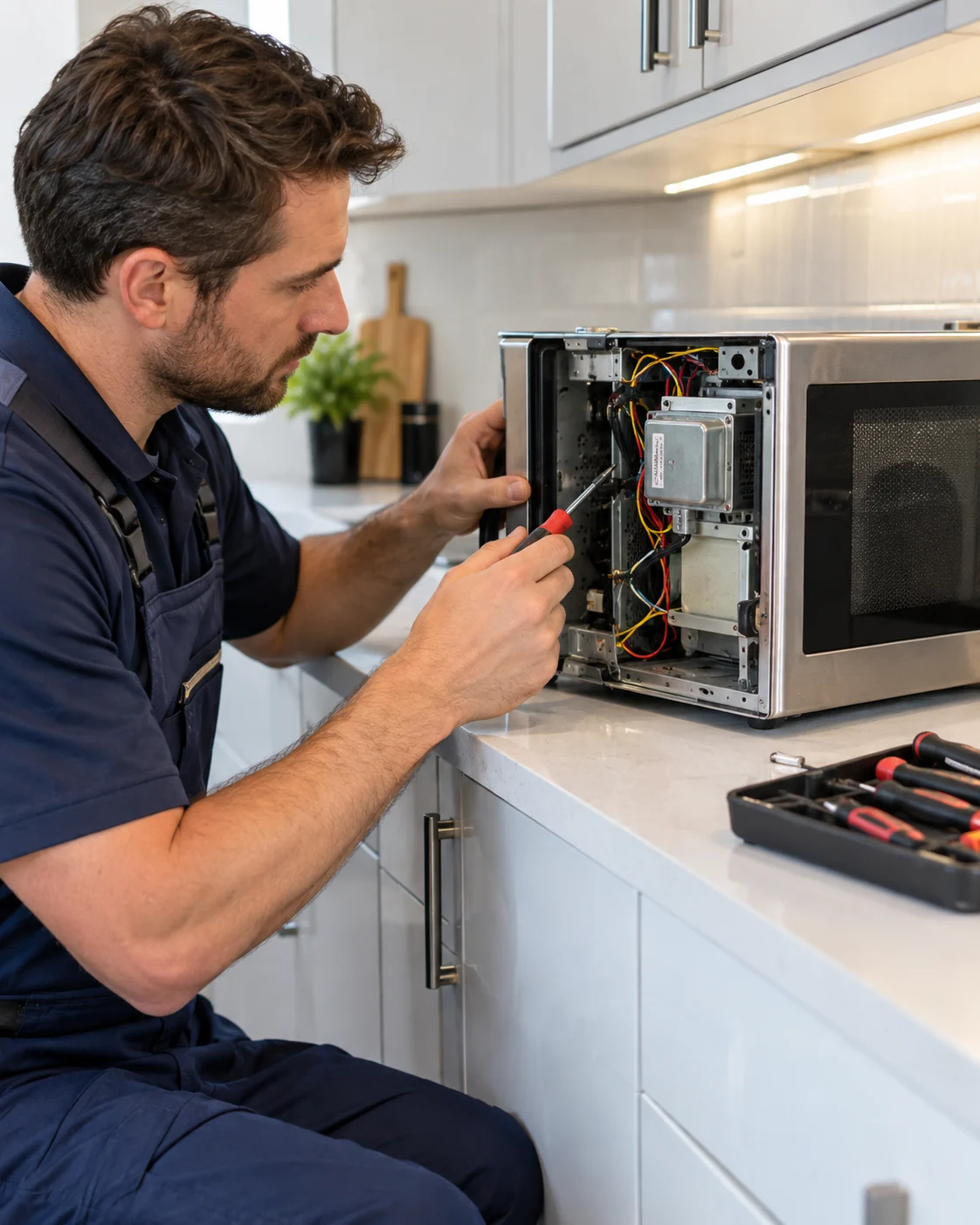
Common microwave problems we diagnose
Microwave symptoms often overlap, so diagnosis starts with the sequence of events: what the microwave still does normally, what changed first, when the problem appears and whether an error code, leak, noise or power event came with it.
Microwave runs but does not heat
A magnetron, high-voltage diode, capacitor, transformer or inverter-related fault may be involved, but these components are not safe DIY test points. Door-interlock or control issues can also affect operation.
Microwave will not start
The door switches and latches, control panel, power supply, fuse and main control may interrupt the start sequence. External checks can include the outlet and door closure without opening the cabinet.
Microwave trips the breaker
A shared or overloaded circuit, internal short, damaged power cord or high-voltage fault can cause a trip. Repeatedly resetting the breaker without diagnosis is not a safe solution.
Turntable is not rotating
The turntable motor, coupler, roller guide or control function can stop rotation. Confirm the tray and roller are seated correctly before assuming an electrical fault.
Microwave makes unusual noise
Buzzing, grinding or arcing can come from the turntable drive, cooling fan, high-voltage system or metal/food debris in the cavity. Visible arcing is a stop-use condition.
Display or buttons do not respond
Control lock, touch membrane, user interface, door sensing, low-voltage power supply or main control may affect input.
What diagnosis may involve
Door safety, power and high-voltage heating are separate systems.
For microwave problems, report whether the display works, whether the fan and turntable run, whether there is any heat, whether the breaker trips, and whether you have seen arcing or smelled burning.
- door interlock switches
- turntable motor and coupler
- cooling fan
- user interface
- main control
- magnetron
- high-voltage diode and capacitor
- inverter on applicable models
A microwave can have a working display and turntable while the heating system fails. Internal high-voltage diagnosis is not a safe homeowner task and should not be approached by trial-and-error parts replacement.
How microwave repair service works
- Describe the appliance and symptom. Share the brand, model number if available, what the appliance is doing and when the behavior began.
- Separate safe checks from stop-use conditions. Basic external observations can help, but unsafe electrical, gas or active-leak conditions should not be repeatedly tested.
- Confirm the affected system. Diagnosis should distinguish faults that produce similar symptoms instead of selecting a part from the symptom alone.
- Discuss the practical next step. Appliance condition, repeat breakdowns, parts availability, safety and expected usefulness all matter when deciding whether to proceed with repair.
- Verify normal operation after service. The affected function should be checked again so the repair addresses the reported complaint rather than only replacing a component.
Important context
Do not open a microwave cabinet for DIY testing.
High-voltage components can store dangerous electrical energy even after the microwave is disconnected. Safe homeowner checks should remain external: outlet power, door closure, control lock, turntable seating and visible cavity condition.
Prepare the model and symptom details for service →What to have ready
Before microwave service, have the manufacturer, full model number, any displayed code and the timing of the symptom ready. Mention recent power interruptions, moving, cleaning, leaks or unusual sounds when they are relevant to this microwave.
Find the appliance model number →Franklin service coverage
Microwave Repair across Franklin neighborhoods
Microwave service is provided for residential customers across Franklin. The service-area pages add appointment and access context for individual neighborhoods while this page stays focused on the microwave problem itself.
Related microwave troubleshooting
Microwave Repair questions
What should I tell you about my microwave problem?
Describe what the microwave does and does not do, when the issue started, any error code, unusual noise, smell, leak or recent power event, and the model number if available.
Is it safe to keep using the microwave?
Stop using the microwave if there is smoke, sparking, severe overheating, repeated breaker trips, uncontrolled water reaching electrical components or any other immediate safety concern. For gas cooking equipment, a gas odor is also a stop-use condition.
Do I need to know which part failed?
No. Describe what the microwave does, what it no longer does and when the change started. Diagnosis is used to determine the responsible system or component after those observable clues are collected.
How do I decide whether to repair or replace it?
For a microwave, consider age, overall condition, previous failures, parts availability, safety and current performance rather than age alone. The repair-or-replace guide provides a structured way to assess those factors.
Independent appliance repair
Brands we service for this appliance category
Service requests can be prepared for these confirmed appliance brands. Model and serial details help identify the exact product before the visit.
Samsung
Refrigerators, washers, dryers, dishwashers, ranges and microwaves.
Samsung appliance repair in Franklin →LG
Refrigerators, washers, dryers, dishwashers, ranges and microwaves.
LG appliance repair in Franklin →Whirlpool
Refrigerators, freezers, ice makers, washers, dryers, dishwashers, ranges and microwaves.
Whirlpool appliance repair in Franklin →GE
Refrigerators, freezers, ice makers, washers, dryers, dishwashers, ranges and microwaves.
GE appliance repair in Franklin →Frigidaire
Refrigerators, freezers, washers, dryers, dishwashers, ranges and microwaves.
Frigidaire appliance repair in Franklin →Bosch
Refrigerators, dishwashers, ranges, wall ovens and microwaves.
Bosch appliance repair in Franklin →KitchenAid
Refrigerators, dishwashers, ranges, wall ovens and microwaves.
KitchenAid appliance repair in Franklin →Maytag
Refrigerators, washers, dryers, dishwashers, ranges and microwaves.
Maytag appliance repair in Franklin →Franklin, Tennessee
Need help with your microwave?
Tell us the microwave brand, full model number if available and the specific behavior you are seeing now.