Why does the cycle sequence matter?
Washers do not jump directly from washing to high-speed spin. They may drain, redistribute the load, verify the door or lid lock and confirm that the tub can accelerate safely. A failure at any of those steps can stop the machine before full spin.
Watch what happens after the water leaves the tub. Does the machine attempt to tumble or agitate? Does the lock indicator change? Does the tub move slowly and stop? Those observations are more useful than simply reporting “no spin.”
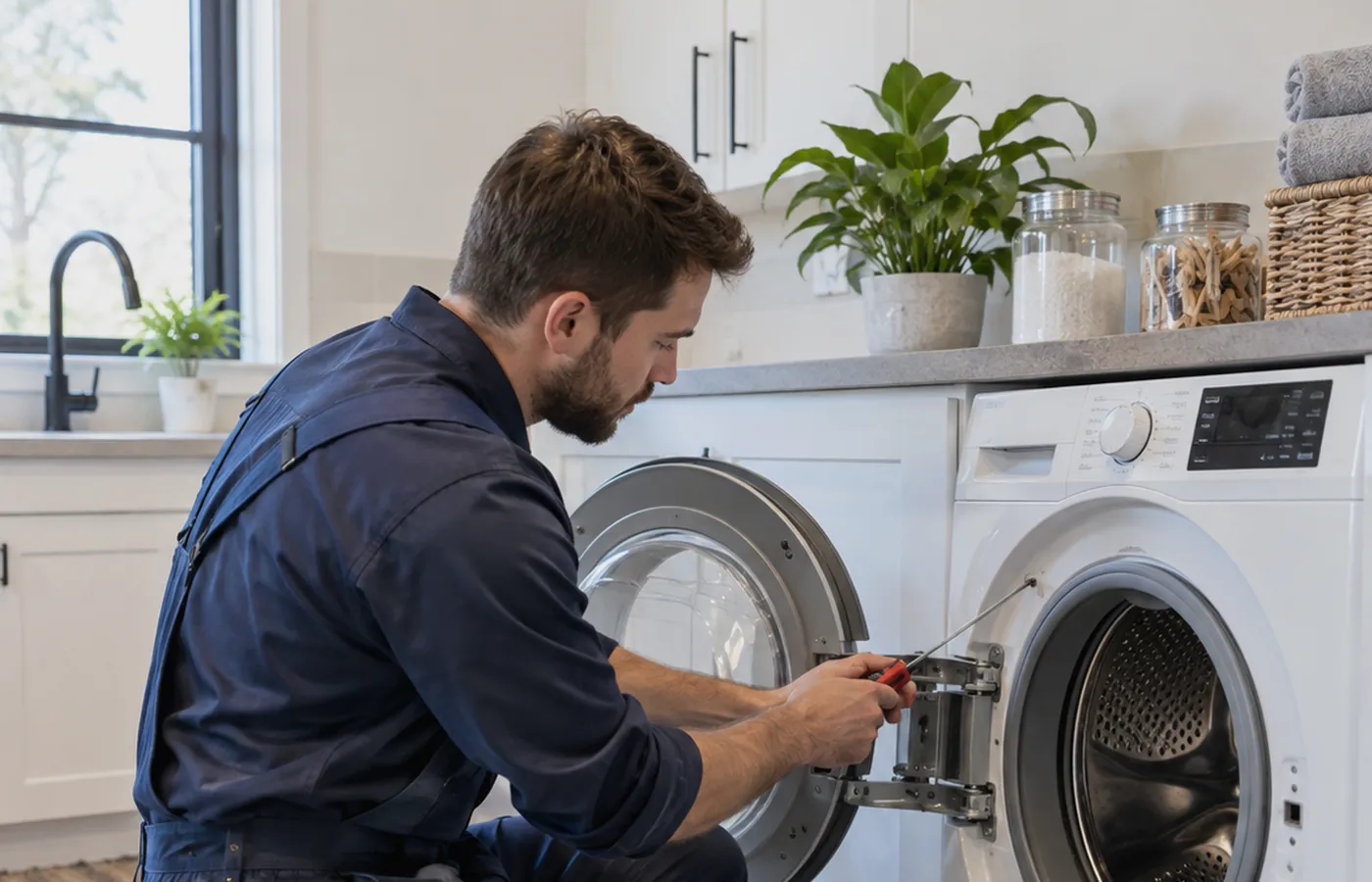
Door and lid-lock systems can block spin.
Modern washers use interlocks to prevent high-speed movement with the door or lid open. A lock that does not engage, a damaged latch or a control that cannot confirm the locked state can allow draining while blocking spin.
Do not bypass the lock or defeat the safety circuit. If the door is physically closing but the machine does not recognize it, diagnosis should focus on the latch, switch, wiring and control relationship for that model.
An unbalanced load can look like a mechanical failure.
Heavy towels, a single blanket or mixed items can collect on one side of the tub. Many washers will slow down, redistribute or abandon spin when the control detects excessive imbalance.
Try a normal manufacturer-approved redistribution with a reasonable load. If the washer repeatedly goes out of balance with ordinary loads, suspension rods, shocks, tub support or other mechanical conditions may need attention.
Drive-system faults depend on washer design.
Some washers use belts, some use direct-drive systems, and others use clutches or couplers. A machine that drains normally but cannot accelerate the basket can have a fault in the drive path even though the pump is working.
Because platforms differ, advice that applies to one brand or model may be wrong for another. The model number is essential before interpreting motor noises, belt condition or control codes.
Sensors and controls decide whether spin is allowed.
Speed sensors, pressure sensors and control boards can prevent spin if the machine does not receive the expected feedback. For example, a control that still believes water is present may not allow the high-speed phase even if the tub appears empty.
Error codes can help, but a code describes what the control detected, not always the failed component. Use it as a starting point for testing rather than as an automatic parts instruction.
When does the symptom need diagnosis?
If the washer drains consistently, the load is reasonable, the door or lid closes normally and manufacturer-approved reset steps do not restore spin, the next step is model-specific diagnosis of the lock, balance, drive and control systems.
Stop using the washer if it develops violent movement, grinding, smoke, electrical odor or active leakage. Those conditions add safety and property concerns beyond the original no-spin complaint.
No-spin clues after the washer drains
| Observation | Possible system | Useful next detail |
|---|---|---|
| Door does not lock | Latch/interlock system | Does the lock indicator change? |
| Tub moves slowly then stops | Balance, drive or control | Is the load distributed evenly? |
| Repeated banging | Suspension or load balance | Does it happen with normal loads? |
| Motor sound, little basket movement | Drive system | Model/platform type matters |
| Error code appears | Sensor/control feedback | Record exact code before reset |
The observations narrow the system; they do not identify a component without testing.
What can you check before scheduling service?
- Remove an obviously unbalanced load. Redistribute clothing according to the manufacturer’s instructions.
- Confirm the door or lid closes fully. Do not bypass the safety lock.
- Record any code. Photograph the display before clearing it.
- Run only a normal safe cycle test. Stop if the machine bangs violently, leaks or smells electrical.
- Find the model number. Platform-specific information makes diagnosis more precise.

Frequently asked questions
Can a washer drain if the motor is bad?
Depending on the design, the drain pump can be separate from the main drive motor, so draining does not prove that the spin drive is healthy.
Why does my washer keep trying to balance the load?
The control may be detecting uneven tub movement. Load distribution, suspension components and machine leveling can all contribute.
Should I replace the door lock because the washer will not spin?
Not without diagnosis. A lock fault is one possibility, but drive, sensor and control issues can produce similar behavior.
Can I keep using a washer that bangs during spin?
Repeated severe movement can worsen mechanical or property problems. Stop and investigate the cause rather than treating it as normal noise.
Related Franklin appliance resources

Harpeth Appliance Works Editorial Team
This guide explains “Why Does My Washer Drain but Not Spin?” for Franklin homeowners, with symptom-specific observations, safe external checks and the information that helps prepare a washer service request.
Editorial responsibility →